
Menu
Why Integration is the Backbone of Modern Retail
Published on October, 2026
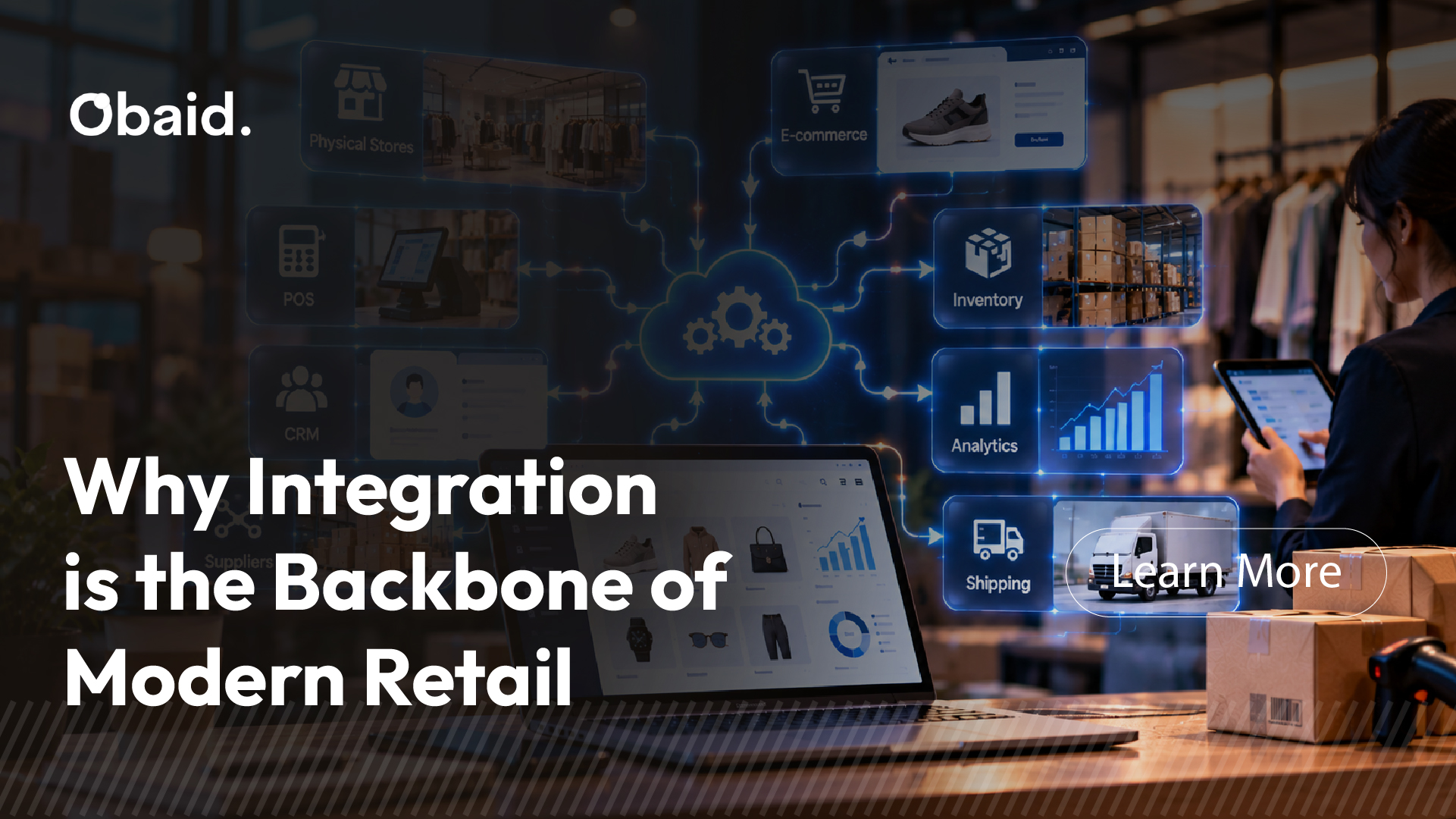
Selling on a single channel is rarely enough nowadays.
For example:
Consider a small clothing brand with one store in Lahore and a website. A customer walks into the store and buys the last blue kurta in medium. At the same moment, someone in Karachi is looking at that exact same kurta on the website, sees “in stock,” and orders it. Ten minutes later, someone from the brand has to call that Karachi customer and apologize that the kurta is gone and the website just didn’t know yet.
This happens every single day across retail businesses that look modern on the outside but are quietly disconnected on the inside. Customers move freely between a brand’s website, marketplaces like Daraz, WhatsApp, social media, and sometimes physical stores. They expect product availability, prices, order status, and support to feel consistent no matter where they interact. That consistency is only possible when systems talk to each other. This is integration, the ability of different software and platforms to share data and work as one.
This has become the quiet foundation of modern retail. Without it, even strong products and good marketing struggle to deliver a reliable experience.
First, What Does "Integration" Actually Mean?
A retail business usually runs on several separate tools:
- A website
- Point-of-sale machine in the store
- A spreadsheet
- Software that tracks stock
- A system that stores customer details
- A delivery service
On their own, each of these tools works fine. The problem starts when they don’t talk to each other.
Integration is the technical work of connecting these tools so that information moves between them automatically. When a sale happens anywhere, i.e., in a store, on a website, or through a phone order, every other system that needs to know about it finds out within seconds, without a human re-typing anything.
Without integration, a business is really running several small, disconnected businesses under one name, i.e.
- An online business,
- A store business,
- A customer service business
All working from slightly different, slightly outdated information.
The Cost of Disconnected Systems
Poor integration is expensive. Research from the UK retail sector shows that 60% of retailers report financial losses linked to disconnected systems. Nearly half lose more than £50,000 a year, and one in ten report losses exceeding £1 million annually. During peak periods such as Black Friday, nearly a third experience direct revenue damage because systems cannot keep up.
These numbers are not unique to one market. The underlying problems are familiar everywhere:
- Order errors
- Stock mismatches
- Delayed updates
- Manual data entry
- Teams spending more time fixing issues than improving the business
In Pakistan, where many brands sell across Daraz, their own website, WhatsApp, and multiple courier partners, the same risks appear in different forms, i.e.:
- Incorrect inventory counts
- Delayed COD reconciliation
- Customer service teams working with incomplete information
What Good Integration Actually Delivers
Accurate stock, everywhere, all the time
A product that sells out on one channel automatically disappears from every channel within seconds, instead of staying listed as available and causing order cancellations.
Faster, more reliable checkout
Payment, inventory, and order systems working together means fewer failed transactions and fewer “sorry, that’s actually out of stock” messages after a customer has already paid.
Support that doesn’t waste the customer’s time
A support agent can see a customer’s full order and delivery status in one place instead of asking them to wait while three different departments are contacted.
Lower fulfilment costs
With one accurate view of stock across every location and channel, a business doesn’t need to hold as much safety stock “just in case” two systems disagree.
A single, usable picture of the customer
Order history, preferences, and contact details stay consistent everywhere, which is what actually makes personalized offers, loyalty programs, and faster reordering possible.
Room to grow without rebuilding everything
Adding a new marketplace, a new delivery partner, or a new store becomes a matter of connecting one more piece to an existing system, rather than starting the whole setup from scratch.
None of these benefits require a business to be large or technically advanced first. They are available to any e-commerce business the moment its core systems are properly connected. Which is exactly why integration is described as a backbone rather than a bonus feature. Everything else a business tries to build depends on it holding together.
A Simple Way to Spot the Problem in Any Business
Anyone can check whether a retail business has this problem, even without technical knowledge, by asking a few basic questions:
- If something sells in the store, does the website update in seconds, or hours later?
- Does a customer support agent see the same order details a customer sees, or do they need to “check with the warehouse and get back to you”?
- Can the same product be accidentally sold twice — once online, once in-store — before anyone notices?
- Does a delivery update reach the customer automatically, or does someone have to manually message them?
If the honest answer to most of these is that it takes time or someone has to check manually. Then your business is running on disconnected systems, whether or not anyone inside the company thinks of it that way.
Why This Isn't Just a Technical Detail, But a Financial One
This might sound like an internal, back-office issue that only technical teams need to worry about. The numbers say otherwise.
Research from Bain & Company and Aptos found that 99% of retailers believe integrated, connected systems directly affect their profitability, and 100% say it affects their sales revenue. That belief is turning into action: the 2025 Salesforce State of Commerce report found 54% of retailers now list integration as their top strategic priority, up from just 31% in 2022.
The operational impact is measurable too. Industry data on point-of-sale integration shows retailers with properly connected systems see roughly 9.5% higher revenue, a 37% drop in stockouts, and 30% faster checkout transactions. Integration is now cited by 85% of retail operators as their top purchasing priority when buying new commerce technology.
Stock management shows the clearest gains. Businesses that unify inventory data across every channel typically cut fulfilment costs by 20-30%, and only then can they safely offer things like “buy online, pick up in store” without accidentally overselling. On the customer side, retailers with strong integration report keeping around 89% of their customers, compared to just 33% for retailers running on disconnected systems.
What This Looks Like for an Online-First Brand
It’s tempting to assume integration mainly matters for businesses with physical stores, since there’s no cash register to reconcile online. In practice, an online-only brand often has just as much to connect, e.g.:
- Its own website
- One or more marketplaces
- A social media shop
- WhatsApp orders
- Multiple delivery partners
All of these need to show the same stock numbers and the same customer details at the same time.
Without integration, a product can sell out on a marketplace while the brand’s own website still shows it as available, leading to a cancelled order, which annoys customers.
How This Plays Out in Pakistan
In Pakistan, integration challenges are shaped by local conditions. Many brands start on Daraz for traffic and later add their own Shopify or custom store. They work with several courier companies, each with different tracking and COD processes. Payments may involve:
- JazzCash
- EasyPaisa
- Bank transfers
- Cards.
Customer conversations often happen on WhatsApp.
Without integration, teams end up:
- Copying data between systems
- Reconciling payments manually
- Chasing courier updates by phone or spreadsheet
During high-volume periods such as 11.11, Eid, or major sales, these manual processes break down quickly.
Brands here can create a clearer operational picture if they invest in connecting their store’s:
- Marketplace orders
- Inventory
- Courier partners
- Customer communication
They reduce the daily friction that drains time and margin. Some local fashion and lifestyle brands have already moved in this direction by linking their online stores with warehouse systems and courier APIs, while others still operate with heavy manual coordination.
SAPPHIRE, one of Pakistan’s largest fashion retail groups, grew from its 2014 launch to nearly 50 stores and crossed PKR 30 billion in revenue by fiscal year 2024. According to industry reporting and a formal credit rating report on the company, a major part of that growth came from a backend transformation. SAPPHIRE implemented ERP and CRM tools specifically to integrate:
- Its business processes
- Track inventory
- Customer behavior
- Store performance in real time
The reported result was measurably better sell-through rates and less unsold stock sitting in warehouses.
This is not unique to one brand. Academic research studying 25 major multi-channel textile retailers in Pakistan, including Khaadi, Sapphire, Outfitters, and Gul Ahmed, found that how well brands connect their online and offline operations varies widely across the industry, with some brands years ahead of others simply because they invested early in linking their systems together.
This gap is exactly where local technology has stepped in to help. One Pakistani-built solution, Ginkgo Retail, described in industry coverage as an “Omnichannel Engine,” works by connecting a retailer’s existing point-of-sale systems, including platforms like:
- Microsoft Dynamics,
- Candela
- Shopdesk
- RetailPro
It connects all these to one central, real-time inventory feed shared across every channel a brand sells through. This is exactly the kind of infrastructure that stops a product from being sold in-store and online at the same time.
Looking Ahead
Retail will keep adding new channels and tools, and each one needs a reliable connection to the rest of the business. Customers rarely praise integration the way they praise fast delivery or good design, but they notice right away when it is missing: wrong stock information, late updates, and broken promises.
Remember that the brands that win are rarely the ones with the most tools. They are the ones whose tools work together, and integration is the backbone that makes that possible.

Obaid Arshad
CEO & Co-Founder